This forum is preserved as a permanent archive. The community continues at eMedia Press.

Announcement

Collapse
No announcement yet.

Eric Dollard

Collapse
This is a sticky topic.
X
X
 
  • Filter
  • Time
  • Show
Clear All
new posts

  • Originally posted by dR-Green View Post
    I wasn't referring to Tesla coils, but music. But in basic terms it's the opposite of overtones. It's harmonic frequencies which are below the fundamental frequency, rather than above it. A cymbal for example can produce undertones, because the initial crash can have a certain (high) pitch and a broad range of frequencies somewhat similar to white noise, but a heavy cymbal continues to resonate at a frequency which may be below the initial crash pitch and that continues to ring after the high frequencies have faded.
    I see. Tesla coils don't have resonant frequency lower than the lowest fundamental one. They do have frequency of beats corresponding to the free response of 2 coupled circuits. Of course, they also have higher resonant frequencies becouse of the distributed nature of the secondary circuit.

    Comment


    • Eric Dollard LIVE Call

      Live Eric Dollard call - starting in 24 minutes: Conference Dial-in: 1-857-232-0155, Conference Code: 582590 - starting at 11AM pacific daylight savings time - not pacific standard time.

      @David - I asked your question on the live call last time. Will be posting a YouTube video of that call sometime today.
      Sincerely,
      Aaron Murakami

      Books, Videos, ESTC Conference Info, Blog, etc. https://emediapress.com

      Comment


      • E.P.D Letter to Macak

        This might help:


        Comment


        • Originally posted by Raui View Post
          Doc,
          The 4.8*10^9 / F comes from the simplification of;

          Since;

          We can say that;

          Or at least very close to.

          The reference to the first equation comes from;


          In the figures Eric gave you you'll see that the extra coil wire length is smaller than quater wave at luminal velocity. The way I think about it however is if you have more meters covered per second and your frequency in per seconds stays the same, which it does since we know the specific frequency we're tuning for, the wavelength will naturally have to be longer not shorter. Here's another way to think about it get your hands and move them a certain distance apart in one second and take a quarter of that distance. Now compare it to moving them further apart than the first time and take a quarter of that, assuming it was covered in the same time the distance is longer and not shorter than the original since the time is the same. At least that's how I'm seeing it

          No problem about the books, Garrett was the one that pointed me in the direction of a digital copy of Introduction to Circuit Theory and I found Theory of Linear Physical Systems while I was on the same website (Hathi-trust) so he is to thank for it as well. The only thing I did was 'extract' the images from the digital library and combined them into a pdf

          EDIT: Btw just a quick update on the SEC/Extra coil experiment, I want to make sure that I reduce the number of variables I'm dealing with so I'm having to make a coil form for each coil. I don't have the right drill bit I need. Dad said he'd pick me one up from the hardware store of the way home so hopefully tonight I'll be able to start winding the coils.

          Also, Aaron this isn't my forum and I truly mean no disrespect but I'm finding it really frustrating having to navigate through 3 topics instead of one. I don't know if anyone else is in the same boat but I'd like to see all 3 topics merged into one. I know that you're trying to stop posts getting deleted but when posts are getting deleted it's the authors of those posts who are deleting them. Also why is it that it's only this topic which is getting continuation topics while the others which have just as many people posting, if not more, aren't?

          Raui
          Hello Raui,

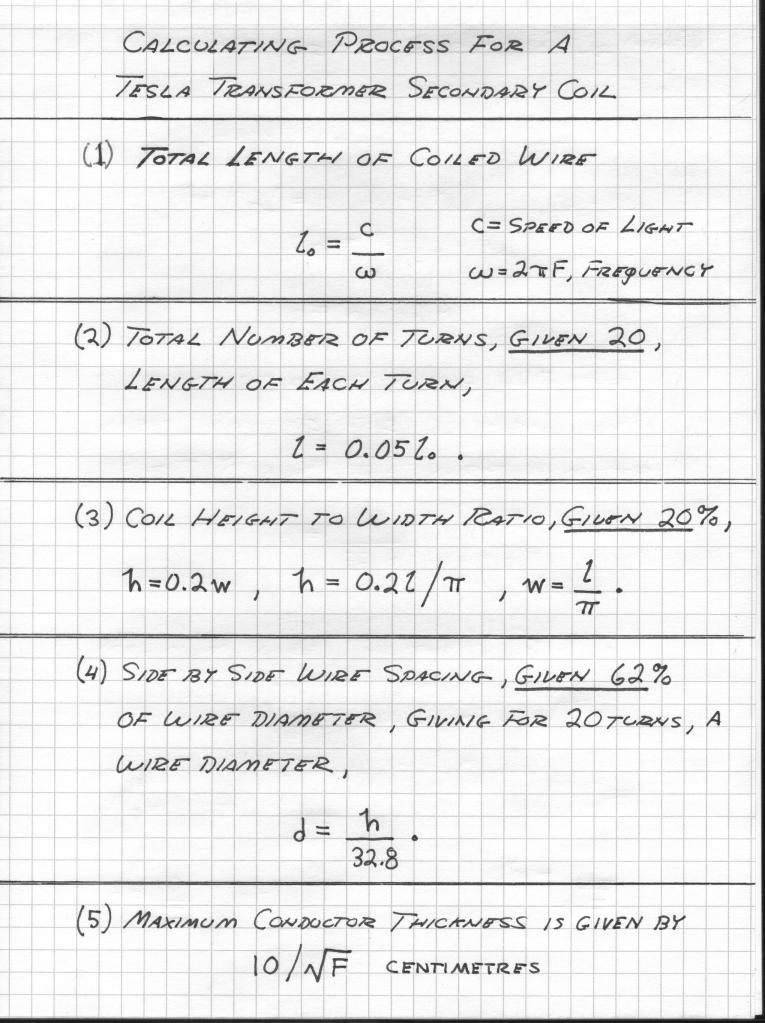
          You have showed the calculation of the secondary of Tesla transformer.
          I only would like to ask you of the "GEVEN" 20% ratio H/W
          (height/diameter of the coil). Please, could you explain why 20% ? Where from this ratio? What will be if to use a GOLDEN RATIO = 1.618?

          Comment


          • Phi?

            Originally posted by Alexg800 View Post
            Hello Raui,

            You have showed the calculation of the secondary of Tesla transformer.
            I only would like to ask you of the "GEVEN" 20% ratio H/W
            (height/diameter of the coil). Please, could you explain why 20% ? Where from this ratio? What will be if to use a GOLDEN RATIO = 1.618?
            "Doesn't matter how many times you kick the coyote in the head, it's still gonna eat chickens". - EPD

            Comment


            • Hello Sputins,

              Thanks for your fast response.
              I see on the pictures that Tesla coils are usually built in according to H>>D, where H - height, D - diameter. What could you advice?
              I am going to build a coil where the wire length is 3.75m, it means that
              1/4 lambda is 3.75m (lambda = 15m, Freq = 20MHz) What diameter and the height of the coil should be chosen in a proper way? What could you advice?

              Alex

              Comment


              • The (almost final) version of that one is actually 6.6% ratio:

                Diameter = 15 Metres
                Height = 1.0668 Metres
                Number Of Turns = 16 (Final Turn Excluded)
                Inclusion of the final turn nearly doubles the height, but Tesla didn't want to include it in the calculations for some reason.
                http://www.teslascientific.com/

                "Knowledge is cosmic. It does not evolve or unfold in man. Man unfolds to an awareness of it. He gradually discovers it." - Walter Russell

                "Once men died for Truth, but now Truth dies at the hands of men." - Manly P. Hall

                Comment


                • Originally posted by Alexg800 View Post
                  Hello Sputins,

                  Thanks for your fast response.
                  I see on the pictures that Tesla coils are usually built in according to H>>D, where H - height, D - diameter. What could you advice?
                  I am going to build a coil where the wire length is 3.75m, it means that
                  1/4 lambda is 3.75m (lambda = 15m, Freq = 20MHz) What diameter and the height of the coil should be chosen in a proper way? What could you advice?

                  Alex
                  Pictures of who's Tesla coils?

                  The optimal proportions will be optimal at all sizes because it's based on the geometry and, height to diameter ratio. 0.2 = 1/5 = 20/100

                  No part of this is meant to make big sparks and waste energy as the rest of the internet would have you believe, so if you want to make things that actually work you can start with the 20% ratio.

                  But it's not as if nothing will work if you don't do that, you can literally make a pile of old junk work. What's more important is what you learn in the process of building it and getting it to work. After you build this one you will have gained valuable knowledge for the next one.
                  http://www.teslascientific.com/

                  "Knowledge is cosmic. It does not evolve or unfold in man. Man unfolds to an awareness of it. He gradually discovers it." - Walter Russell

                  "Once men died for Truth, but now Truth dies at the hands of men." - Manly P. Hall

                  Comment


                  • Originally posted by dR-Green View Post
                    Pictures of who's Tesla coils?

                    The optimal proportions will be optimal at all sizes because it's based on the geometry and, height to diameter ratio. 0.2 = 1/5 = 20/100

                    No part of this is meant to make big sparks and waste energy as the rest of the internet would have you believe, so if you want to make things that actually work you can start with the 20% ratio.

                    But it's not as if nothing will work if you don't do that, you can literally make a pile of old junk work. What's more important is what you learn in the process of building it and getting it to work. After you build this one you will have gained valuable knowledge for the next one.
                    Hello,

                    Thanks for your reply. So I am going to build the coil with the ratio H/D = 20% !!!
                    I only do not understand in the calculation why the wire length must be equal to lambda. In the literature and TESLA patents a quarter of lambda is mentioned. In this case the upper end of the coil will be a high voltage node.
                    In case of wire length is equal to lambda the upper end is not a high voltage node.
                    Also in the current calculation nothing mentioned of the LC resonance of the coil. Should LC resonance frequency of the coil corresponds to the working frequency of the coil or not? Can matching LC resonant frequency and working frequency give any advantages?

                    Comment


                    • Originally posted by Alexg800 View Post
                      Hello,

                      Thanks for your reply. So I am going to build the coil with the ratio H/D = 20% !!!
                      I only do not understand in the calculation why the wire length must be equal to lambda. In the literature and TESLA patents a quarter of lambda is mentioned. In this case the upper end of the coil will be a high voltage node.
                      In case of wire length is equal to lambda the upper end is not a high voltage node.
                      Also in the current calculation nothing mentioned of the LC resonance of the coil. Should LC resonance frequency of the coil corresponds to the working frequency of the coil or not? Can matching LC resonant frequency and working frequency give any advantages?
                      Hi, the wire length is 1/4 wavelength. The L and C are both based on the geometry of the coil, so that is already factored into the calculations. That's why the wire length is in fact about 0.68*1/4 wavelength.
                      http://www.teslascientific.com/

                      "Knowledge is cosmic. It does not evolve or unfold in man. Man unfolds to an awareness of it. He gradually discovers it." - Walter Russell

                      "Once men died for Truth, but now Truth dies at the hands of men." - Manly P. Hall

                      Comment


                      • Originally posted by dR-Green View Post
                        Hi, the wire length is 1/4 wavelength. The L and C are both based on the geometry of the coil, so that is already factored into the calculations. That's why the wire length is in fact about 0.68*1/4 wavelength.
                        Hi dR-Green,
                        It is splendid that "the L and C both based on the geometry of the coil".
                        I did not know it and thought how to do it, but here it is already done. Nice!
                        Concerning the wire length, look on the formula (1)
                        " Total length of Coiled Wire: Lo = C / W, C -speed of light, W = 2Pi X F."
                        Where is 1/4 wavelength. May be I do not understand anything?
                        Look:
                        Frequency - Wavelength Chart
                        Last edited by Alexg800; 04-18-2016, 01:15 PM.

                        Comment


                        • Since the primary is only a single turn, it seems like an adjustable capacitance on the primary to tune in to the secondary's resonance point is crucial. However, it does not seem crucial for the secondary coil to be resonating at it's natural LC frequency unless you are looking for the highest Q possible. Using just the 1/4 wavelength wire on the secondary, nodes should still occur, regardless of the relationship between the coils inductance and capacitance. Am I off base here?

                          Comment


                          • Originally posted by Alexg800 View Post
                            Hi dR-Green,
                            It is splendid that "the L and C both based on the geometry of the coil".
                            I did not know it and thought how to do it, but here it is already done. Nice!
                            Concerning the wire length, look on the formula (1)
                            " Total length of Coiled Wire: Lo = C / W, C -speed of light, W = 2Pi X F."
                            Where is 1/4 wavelength. May be I do not understand anything?
                            Look:
                            Frequency - Wavelength Chart
                            There have been a few updates recently as well as different variations originally.

                            The latest calculations are in the CRI video. There, Lo = 1/4*0.78*C/F

                            The 20% H/D ratio sets the propagation velocity of the coil through the geometry, which will cause the frequency of a 1/4 wavelength wire length to be too low. So in order to compensate for it, the wire length is made shorter to bring the frequency back up to the original value.

                            If the same length of wire was wound with a different geometry then the propagation velocity would be different, and so the resultant frequency. Because both L and C depend on the geometry.
                            http://www.teslascientific.com/

                            "Knowledge is cosmic. It does not evolve or unfold in man. Man unfolds to an awareness of it. He gradually discovers it." - Walter Russell

                            "Once men died for Truth, but now Truth dies at the hands of men." - Manly P. Hall

                            Comment


                            • dR-Green,

                              Good to see you back..

                              What have you been constructing or experimenting with recently? What have you been up to or planning?
                              "Doesn't matter how many times you kick the coyote in the head, it's still gonna eat chickens". - EPD

                              Comment

                              Working...
                              X