This forum is preserved as a permanent archive. The community continues at eMedia Press.

Announcement

Collapse
No announcement yet.

How to Move Mountains... Leedskalnin Style

Collapse
X
 
  • Filter
  • Time
  • Show
Clear All
new posts

  • Originally posted by Loadstone View Post
    Hey Harvey...what page 36 in Ed's notes?
    Magnetic current has only 20 pages

    I've done all the tests and have all the results fully documented.
    I made it so that it could be taught to a 16yo.
    The thing is...with Ed's work you have to start from the start, and also you have to forget about electrons and everything else.
    Loadstone try this:
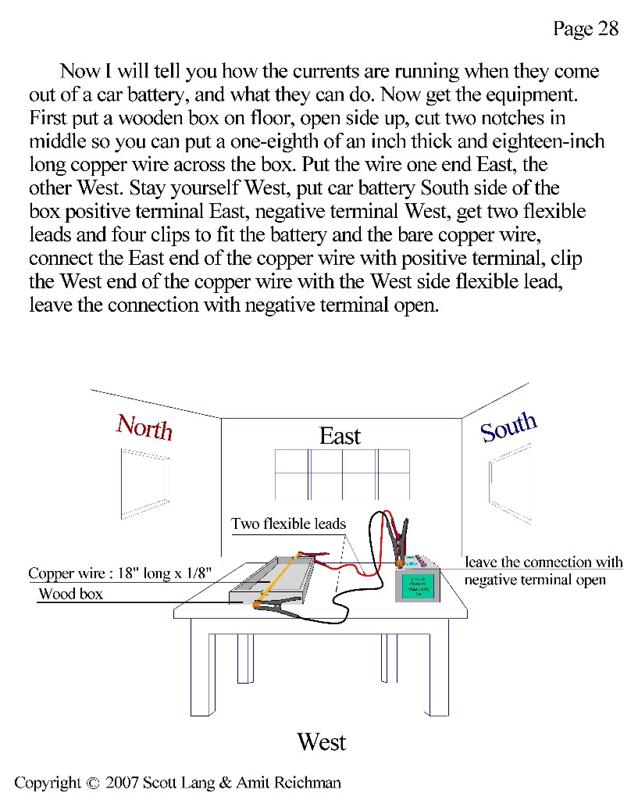
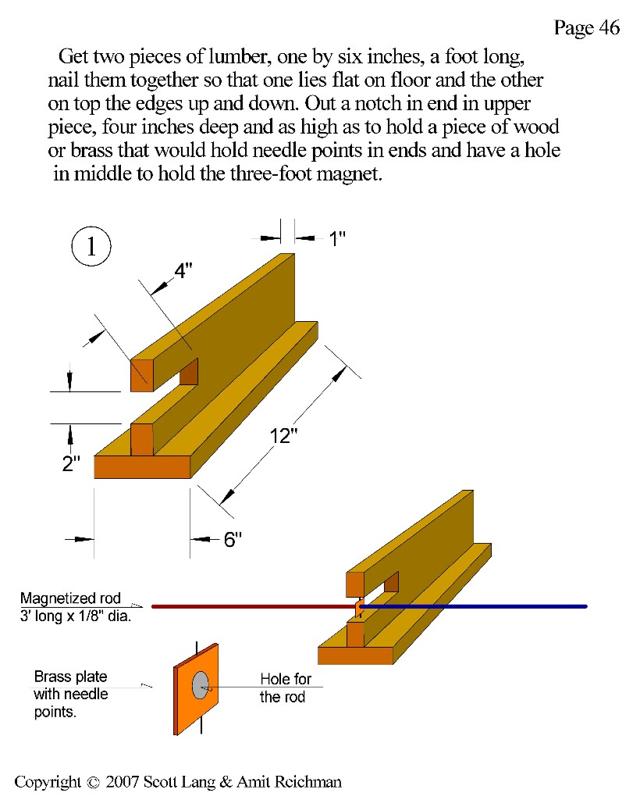
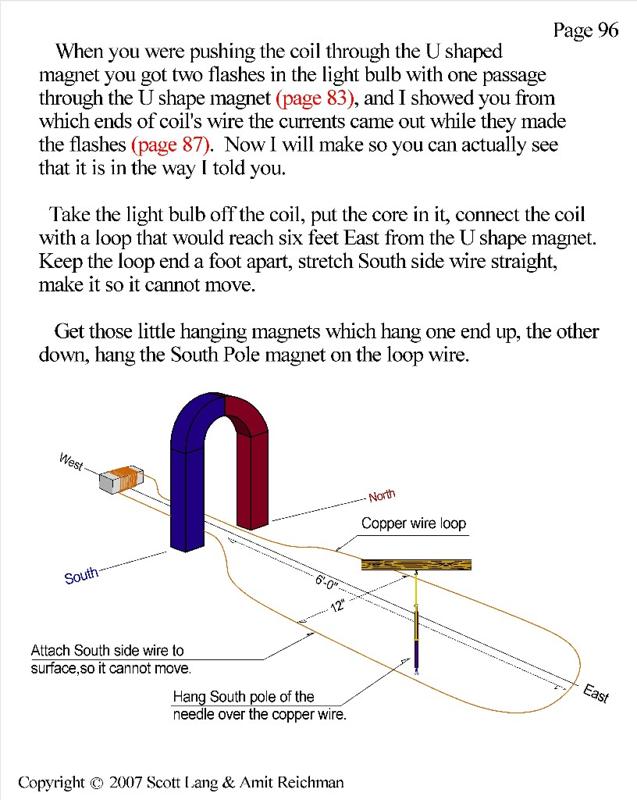
    Ed Leedskalnin - Magnetic Current (Illustrated)
    Thanks Aaron.

    Comment


    • you guy's don't think Ed wrote that do you..

      I was in e-mail contact with the guy when he put those notes on the web.
      They are not written by Ed.

      Comment


      • Here is how my notes are presented.
        Attached Files

        Comment


        • Could the magnetic field surrounding a current carrying wire be a spiral?
          Being a plain electrician and not versed in physics, I thought it was with dc current. Just like looking lengthwise down a coil with the north on one side and south on the other. The top apex being the input point of the current,south pole,and continues around to the bottom apex of the wire. Once the current passes the bottom apex it reverses polarity until it reaches the top apex and reverses polarity again. This is what Ive been taught. Whether this applys to a single wire I dont know but looking at Eds works I thought it would.


          Electricians are taught to connect grounds,neutrals or negative,then hots or positives in that order. Its the reverse order when disconnecting.

          Comment


          • do you have a better source for magnetic currents Loadstone? I thought I was being helpful.

            Comment


            • Hey Red.
              Those notes you posted are ok, but lots of people think Ed wrote them? Not sure why.

              I have my own set of notes that I worked on with a partner.
              Our work was going to be in a book format but kind of drew to a halt due to various reasons.

              The thing is with Ed's notes, you have to do it from the start and model everything. Then cross reference everything with everything else. Takes ages.
              I did a whole bunch of work in the beginning only to later realize I had to tear it all up and start again.

              Some of Ed's experiments can be used to determine more than one thing, but you don't realize that until later.
              I've only made notes following Ed's exact words without making additions, but all kinds of additions could be made.

              L.S

              Comment


              • Originally posted by Loadstone View Post
                Hey Harvey...what page 36 in Ed's notes?
                Magnetic current has only 20 pages

                I've done all the tests and have all the results fully documented.
                I made it so that it could be taught to a 16yo.
                The thing is...with Ed's work you have to start from the start, and also you have to forget about electrons and everything else.
                My copy has thirty-nine numbered pages, some of which have decimal insertions like 21.1 and is comprised of 51 leafs due to the fact that Ed did not number some of the heading pages.

                I have it in PDF form if you would like a copy. As far as I know Ed has no living heirs and even though his copyright extends for 120 years beyond his death I do not know of any existing entity whereby the copyrights have been transferred.

                Or you can download it directly from here:
                Ed Leedskalnin - Magnetic Current (Illustrated)


                I guess someone has grabbed the Illustrated version, made some covers for it and is selling it on Amazon:
                Amazon.com: Magnetic Current (9781453694145): Edward Leedskalnin: Books

                BTW, I learned what Ed.L stood for after reading page 6. The L stands for 'Location'
                Last edited by Harvey; 01-03-2011, 08:27 AM.
                "Amy Pond, there is something you need to understand, and someday your life may depend on it: I am definitely a madman with a box." ~The Doctor

                Comment


                • Originally posted by Loadstone View Post
                  @ Harvey....you wrote about the cable sticking to the battery....
                  Ed wrote:
                  "Get four pieces of wire size sixteen, six inches long, two copper and two soft iron, bend one end of each wire back so the clips can hold it better. Use copper wire first. Put both wires in clips, connect with battery, have the wire ends square, now put the loose ends together, and pull them away. Then you will notice that something is holding you back. What is it? They are magnets. When you put the ends together, the North and South Pole magnets are passing from one wire to the other, and in doing it they pull the wire ends together. Now put the soft iron wire in the clips, put the loose ends together, and pull them away. This time the passing magnets hold the wire ends together stronger."
                  --------------------------
                  If the electrons travel better in the copper, why does the iron wire pull together more?
                  I agree with Ed here.

                  There may be an effect occurring that is similar to how I made magnetic Aluminum in this video YouTube - Giant Paramagnetism In Aluminum Foil using a technique similar to David Lambright's, but I used permanent magnets instead of a pulsed coil. I did write up something on the structure of Aluminum in David's thread here at EF and how it could behave like similar to a ferromagnetic material if the atoms are flipped a specific way in the lattice.

                  It should be noted here however, that in Ed's case, the restructuring is due to Current Flow and in David's case the restructuring is due to Magnetic Flux. The Magnetic Flux and the Current are always orthogonal to each other.

                  Anyone that has done any amount of arc welding knows well that the rod will adhere to the work in a way that takes considerable effort to break it free if the rod touches the work and fails to strike the arc. It is so easy to just jump to the conclusion that this a fast spot weld but after pondering these things I am much more inclined to consider magnetic attraction as the primary holding power involved. It would certainly be worth investigating in full measure.

                  There may be a unique relationship between the magnetism and current at the face of the wire end that is different from the middle of the wire. There may be a rotation or a divergence of the two in such a way that the magnetic field wraps around the end of the wire and twists up tight in the air gap there changing from a loose circular spiral to a a tight helix. I don't think there is one single spiral from end to end, I think there are millions of them side by side for each moving electric charge inside the wire and when you pull them apart across the air gap they trade pitch for diameter in order to conserve the circumferential length. In this case the magnetic flux stretches to align with the wire and the charged particles begin spiraling in the air gap where they were going relatively straight down the wire. So the air gap acts like a reservoir to hold more charges swirling around and the added energy density saturates the air into a plasma and the arc is formed.

                  Has anyone ever stuck a TIG welder tip to the work? I don't thing those tips will 'weld' themselves because the materials are too dissimilar and the tip is made to withstand the arc temperatures without melting too much. So if they actually stick to the work . . . perhaps its a magnetic bond
                  "Amy Pond, there is something you need to understand, and someday your life may depend on it: I am definitely a madman with a box." ~The Doctor

                  Comment


                  • I wonder if an electron releases a photon as the nucleus of the atom pulls it back into normal orbit, what happens to a free electron that isn't orbiting an atom.
                    It would probably stay in the energized state until acted upon by another force.
                    Cool vid on the aluminum

                    Hey I was wondering anyone in the central Texas area.

                    David
                    Half of the Answer is knowing the right Question

                    Comment


                    • Originally posted by Dave45 View Post
                      I wonder if an electron releases a photon as the nucleus of the atom pulls it back into normal orbit, what happens to a free electron that isn't orbiting an atom.
                      It would probably stay in the energized state until acted upon by another force.
                      Cool vid on the aluminum

                      Hey I was wondering anyone in the central Texas area.

                      David
                      Hello Dave, from what I've read, electrons in the atoms on the surface of metals are constantly being converted to forms oxidation from exposure to oxidizers. As for energized electrons, general theories of electricity say they are only excited when a force, one such as voltage is applied to them and are provided a pathway to a workload and from it, back to the attraction side of the voltage source. The load presents a " Hole" for the electron to move to, this leaves a hole behind it for another electron from the source to move into, so on, and this continues. This creates an imbalance in the source, which creates "Holes" on the "positive" side of the source allowing electrons to move forward in a current, so to speak, and complete the circuit....This is all in simplified D.C. of course, The coolest thing to me was when years ago I was able to put a magnetic amp meter on a cars starter cable and see the magnetic field of the current shown on the meters face, (analog type with scale and pointer). That was 1980 and was when I first became interested in electricity and magnetisim. I don't know how old you are Dave, but I like your questions......Wally
                      Last edited by Rubberband; 01-03-2011, 07:43 PM.

                      Comment


                      • Hey Wally
                        Turned 51 a couple of days ago, just a pup
                        Speaking of the right question, the one everyone should be asking is how does a thunderstorm produce electricity, when you figure that out you will have free energy.
                        Its a lot simpler than you think, but conditions have to be just right

                        David
                        Half of the Answer is knowing the right Question

                        Comment


                        • Originally posted by Dave45 View Post
                          Hey Wally
                          Turned 51 a couple of days ago, just a pup
                          Speaking of the right question, the one everyone should be asking is how does a thunderstorm produce electricity, when you figure that out you will have free energy.
                          Its a lot simpler than you think, but conditions have to be just right

                          David
                          We are probably getting off topic here.

                          Sky voltage - Wikipedia, the free encyclopedia

                          http://www.atmos.washington.edu/~harrison/reports/grl4b.pdf

                          Triboelectric effect - Wikipedia, the free encyclopedia

                          Condensation - Wikipedia, the free encyclopedia

                          Dew point - Wikipedia, the free encyclopedia

                          Consider that dust particles in the atmosphere become electrically charged specific to their altitude at a rate of 120V per meter. Next consider an event whereby condensation occurs at 15,000m so that the droplets condensing on the dust (or other cooler drops) also becomes charged to 1.8 million volts (120 * 15,000) such that we now have a cumulonimbus. Add to this, that certain solar interaction can add additional energy and that air friction also can add energy by the triboelectric effect and before you know it, you have a good sized cluster of water with a huge electrical charge floating up there. Next, we create a dielectric blanket of air around the cloud because like charged mobile air molecules are pushed away and we get more vacuum (and lower pressure) around the cloud and we have a well contained energy envelope.

                          All that is needed now is to bring into close enough proximity of the negative charge (Earth) so that leaders can form between the cloud and the planet and we have the makings for a good lightning strike. Note that the Ionosphere peaks at about 300,000 m well above the Nimbus clouds and so does not play an active roll in voltage conduction directly.

                          However, there is an electromagnetic relationship between the Ionosphere and lighting strikes whereby energy can (and is) transferred between them in resonances known as the Shumann Resonances. These too can exchange energy with the clouds in between.

                          We also cannot overlook the fact that as the clouds move through the Earth's magnetic field, the moving charges must produce voltages in kind as much as the clouds are serving as conductors.


                          "Amy Pond, there is something you need to understand, and someday your life may depend on it: I am definitely a madman with a box." ~The Doctor

                          Comment


                          • Hey Harvey
                            Iv came up with a different theory, let you know how it goes.
                            David
                            Half of the Answer is knowing the right Question

                            Comment


                            • We are probably getting off topic here.

                              No still on topic
                              Half of the Answer is knowing the right Question

                              Comment


                              • Remember
                                Last edited by Dave45; 01-04-2011, 12:23 AM.
                                Half of the Answer is knowing the right Question

                                Comment

                                Working...
                                X