

 Tweet
Tweet
Thoughts on generating Steam
Vortex said,
"I was thinking there was some psi behind that steam."
No pressure really, unless you restrict the outlet. The pressure cap I seem to remember was about 5 or 7lbs.
I know that by putting the steam outlet under water, there is a cracking sound and the bucket or whatever, vibrates with the shock waves. Exactly the same occurs with the 'pop-pop' boats, hence the reason they got their name
Do you have an old electric kettle? If the element is okay, you could build a steamer from that, or a washing machine heater. The wallpaper strippers are usually about 2kw and some washing machines use a 3kw heater.
Providing you have reliable pressure relief valves, steam isn't a problem. If it were they wouldn't make steam wallpaper strippers for householders, or the old Mamod model steam engine/boilers for children to play with.
An old paraffin blowlamp would work well to provide instant, or 'flash' steam, simply by coiling some 1/4" copper tube. Anneal it first to soften and re-do as it work-hardens. That way, there is no storage or boiler reqd.. Look at a paraffin blowlamp and that is exactly how the liquid paraffin is instantly heated into a gas!
A little side step here - I made a model boat years ago, using 1/8th welding rod and soldering it together into the design I wanted. This was then covered with tape and car body-filler and sanded to shape. I borrowed the owners lathe at dinner time where I worked and built my first and only single cylinder, oscillating steam engine, crankshaft and flywheel.
I made a boiler form steel sheet metal and brazed cross-tubes running down the centre of the horizontal boiler with a vertical stack at the end. All this had to fit inside the boat which was about 20" long. I now had to think of a way to heat the boiler and provide storage for the fuel.
I finally hit on an idea and hence the reason for digressing. "I'll make a miniature blowlamp out of copper tubing and make a purpose designed fuel tank to sit right at the front in a triangular shape", I thought. But how can I pressurize the tank to force the fuel to the blowlamp-coil at the rear? I used a cycle inner tube valve and soldered it into the tank. It was quite an achievement to see it running when steamed up and we were all surprised to see it in action.
Just to prove the point that making a blowlamp to generate steam if reqd., is not difficult.
There is no problem in getting the steam to condense, the difficulty will be directing the steam in one direction only. Yes, I know the venturi can help here, but some thought needs to be given to this as it is the most critical part of the whole idea. It is indeed identical in many ways to a jet engine and the people who chose the name for their device knew exactly what they had to achieve.
I'm thinking of the model/toy pulse-jet motors that were built as a reasonably simple ways to duplicate the real thing and I keep coming back to the Ram pump idea...
To maximise the power potential, we need more than a simple condensating tube. It's not difficult at all, I feel certain that it will work best as a pulsing action to maximise the potential. Of course if we get it right, it will only be heard as a high pitched oscillating action.
hmmm... I wonder if I ought to build a model Steam-Powered Jet Boat first,
or stick with the Steam-Powered Rocket idea... ?
.
"I was thinking there was some psi behind that steam."
No pressure really, unless you restrict the outlet. The pressure cap I seem to remember was about 5 or 7lbs.
I know that by putting the steam outlet under water, there is a cracking sound and the bucket or whatever, vibrates with the shock waves. Exactly the same occurs with the 'pop-pop' boats, hence the reason they got their name
Do you have an old electric kettle? If the element is okay, you could build a steamer from that, or a washing machine heater. The wallpaper strippers are usually about 2kw and some washing machines use a 3kw heater.
Providing you have reliable pressure relief valves, steam isn't a problem. If it were they wouldn't make steam wallpaper strippers for householders, or the old Mamod model steam engine/boilers for children to play with.
An old paraffin blowlamp would work well to provide instant, or 'flash' steam, simply by coiling some 1/4" copper tube. Anneal it first to soften and re-do as it work-hardens. That way, there is no storage or boiler reqd.. Look at a paraffin blowlamp and that is exactly how the liquid paraffin is instantly heated into a gas!
A little side step here - I made a model boat years ago, using 1/8th welding rod and soldering it together into the design I wanted. This was then covered with tape and car body-filler and sanded to shape. I borrowed the owners lathe at dinner time where I worked and built my first and only single cylinder, oscillating steam engine, crankshaft and flywheel.
I made a boiler form steel sheet metal and brazed cross-tubes running down the centre of the horizontal boiler with a vertical stack at the end. All this had to fit inside the boat which was about 20" long. I now had to think of a way to heat the boiler and provide storage for the fuel.
I finally hit on an idea and hence the reason for digressing. "I'll make a miniature blowlamp out of copper tubing and make a purpose designed fuel tank to sit right at the front in a triangular shape", I thought. But how can I pressurize the tank to force the fuel to the blowlamp-coil at the rear? I used a cycle inner tube valve and soldered it into the tank. It was quite an achievement to see it running when steamed up and we were all surprised to see it in action.
Just to prove the point that making a blowlamp to generate steam if reqd., is not difficult.
There is no problem in getting the steam to condense, the difficulty will be directing the steam in one direction only. Yes, I know the venturi can help here, but some thought needs to be given to this as it is the most critical part of the whole idea. It is indeed identical in many ways to a jet engine and the people who chose the name for their device knew exactly what they had to achieve.
I'm thinking of the model/toy pulse-jet motors that were built as a reasonably simple ways to duplicate the real thing and I keep coming back to the Ram pump idea...
To maximise the power potential, we need more than a simple condensating tube. It's not difficult at all, I feel certain that it will work best as a pulsing action to maximise the potential. Of course if we get it right, it will only be heard as a high pitched oscillating action.
hmmm... I wonder if I ought to build a model Steam-Powered Jet Boat first,
or stick with the Steam-Powered Rocket idea... ?
.


 The inner workings of this device get a little more complicated. First a centrifugal pump is started in motion this gives the water inside it motion but more important imparts to the water inertial forces--things in motion tend to remain in motion---momentum. Next a small amount of steam it intermittently forced into the water filled tube extending from the impeller. This can be considered as a steam bubble, this bubble implodes but it implodes under unequal forces. That is the upstream water side is applying a centrifugal pressure against the bubble pushing it while the downstream side is pulling it, this ensures the implosive force acts in the direction of flow outward with the water,the upstream water accelerates with the implosion and slams into the water downstream of the implosion. This accelerates the water outward faster than the centrifugal forces imparted by the pump and a large pressure wave evolves at the exit nozzle. In this case the exit velocity/pressure is greater than what could be provided by the impeller alone which makes the pump a turbine---a self powered turbine. Victor Schauberger also understood that the implosion will accelerate the media in the tube and this change in inertia is acting in a direction which can accelerate the pump. The key is that the implosion must be intermittent, it must be cyclical in nature as everything is cyclical in nature. The dual opposition to motion must be countered to produce forces that will always act in one singular direction without opposition and in this respect we are dealing with forces and time. Victor Schauberger was a man of genius and his work has been continually taken out of context and misunderstood, In any case what you are proposing has been done in the past. If you want to understand where implosion can go as a technology you need to understand Victor Schaubergers technologies.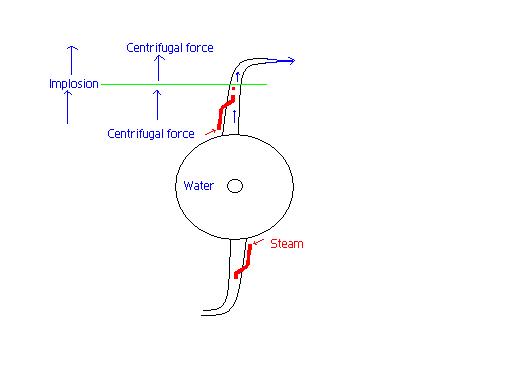
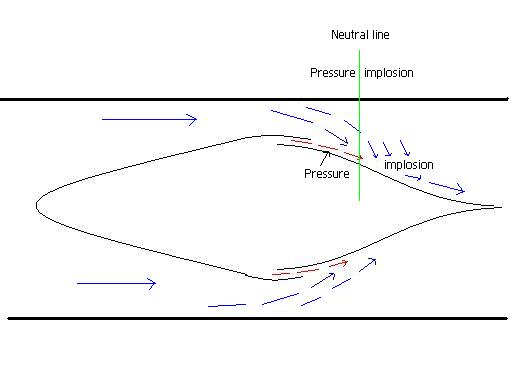


 for finding this article and images.


Comment