

 Tweet
https://books.google.com/books?id=Vt...ens%2C&f=false IMP
https://www.cis.org/Report/Birthrigh...-United-States new
https://www.14thamendment.us/birthri...al_intent.html

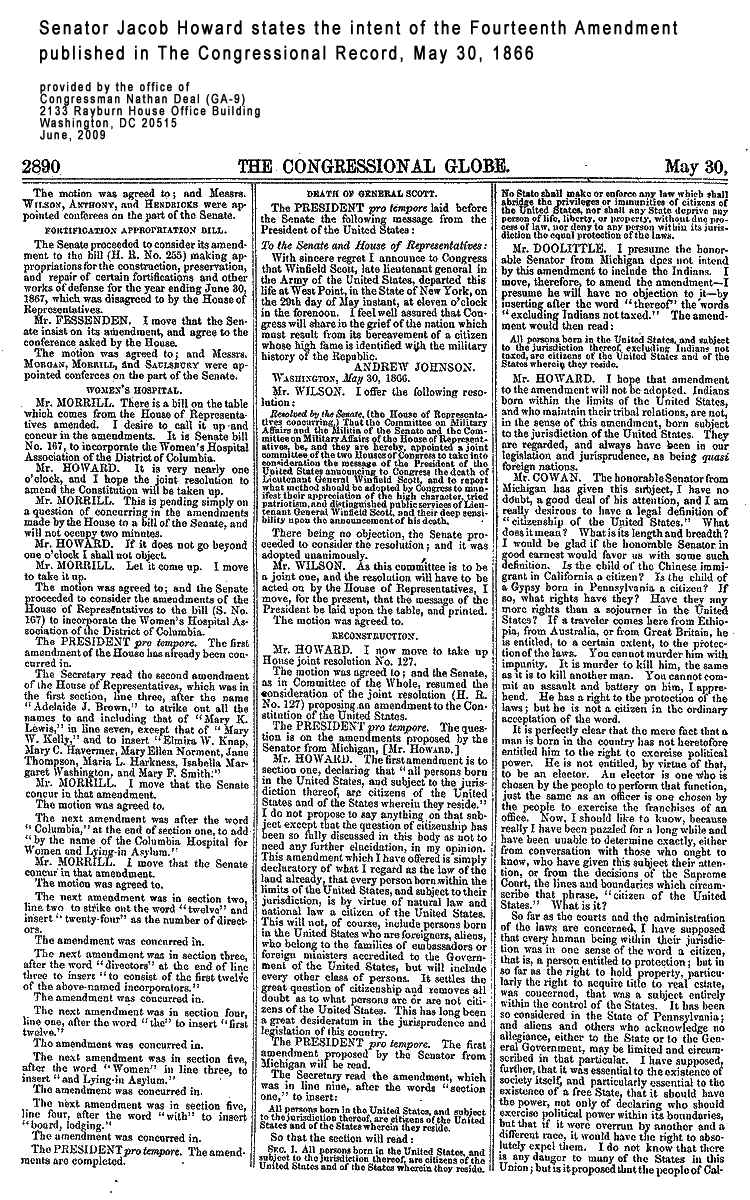
I think the most important point is to corroborate Senator Howard's apparent intention to differentiate between three groups that were to be excluded from citizenship. The excuse came some time ago and is a must to keep the falsehood alive that anyone can come here and have children who automatically become U.S. citizens. The following sentence by Howard must be interpreted with the words foreigners and aliens applying only to foreign ministers and ambassadors.
"citizenship will not, of course, include persons born in the United States
who are foreigners, aliens, who belong to the families of ambassadors or foreign
ministers accredited to the Government of the United States, but will
include every other class of persons"
The correct interpretation of the 14th Amendment is that an illegal alien mother is subject to the jurisdiction of her native country, as is her baby.
The 1884 SC interpretation includes three groups for exclusion, therefore exactly matches what Jacob Howard said 18 years earlier. That anyone born here whose parents are not citizens would not become citizens by happenstance of their foreign place of birth. They are still subject to their jurisdiction, which is not the United States of America.
Over a century ago, the Supreme Court appropriately confirmed this
restricted interpretation of citizenship in the so-called "Slaughter-House
cases" [83 US 36 (1873) and 112 US 94 (1884)]13. In the 1884 Elk v.Wilkins
case12, the phrase "subject to its jurisdiction" was interpreted to
exclude "children of ministers, consuls, and citizens of foreign states born
within the United States." In Elk, the American Indian claimant was
considered not an American citizen because the law required him to be "not
merely subject in some respect or degree to the jurisdiction of the United
States, but completely subject to their political jurisdiction and owing them
direct and immediate allegiance."
The Court essentially stated that the status of the parents determines the
citizenship of the child. To qualify children for birthright citizenship, based
on the 14th Amendment, parents must owe "direct and immediate allegiance" to the
U.S. and be "completely subject" to its jurisdiction. In other words, they must
be United States citizens.
The UnConstitutionality of Citizenship by Birth to Non-Americans - The 14th Amendment to the United States Constitution - Fourteenth Amendment - anchor babies and birthright citizenship - interpretations and misinterpretations - US Constitution
citizenship "will not, of course, include persons born in the United States who are foreigners,
citizenship "will not, of course, include persons born in the United States who are aliens,
citizenship "will not, of course, include persons born in the United States who belong to the families of ambassadors
citizenship "will not, of course, include persons born in the United States who belong to the families of foreign ministers
You are dead wrong. Each sentence separated must make sense. It's already understood that a child of a foreign minister is a foreigner. It's redundant. There was no need to specify that the person born in the U.S. was a foreigner if that was the only class to be excluded from citizenship. The following is how it could've been written if your interpretation were correct: The words, who are foreigners and aliens would be excluded.
citizenship "will not, of course, include persons born in the United States who belong to the families of ambassadors or foreign ministers accredited to the Government of the United States, but will include every other class of persons"
citizenship "will not, of course, include persons born in the United States who are foreigners, who belong to the families of foreign ministers.
What ?Subject to the Jurisdiction Thereof? Really Means
Aliens, among whom are persons born here and naturalized abroad, dwelling or being in this country, are subject to the jurisdiction of the United States only to a limited extent. Political and military rights and duties do not pertain to them. (14 Op. Atty-Gen. 300.)
https://fedsoc.org/commentary/public...o-perspectives
https://www.nationalreview.com/2018/...s-not-mandate/
https://puzo1.blogspot.com/2009/08/l...sh-common.html
https://www.14thamendment.us/article...tionality.html
https://www.14thamendment.us/article...dment_1866.gif
https://www.reddit.com/r/legal/comme...4th_amendment/
https://www.thoughtco.com/diplomatic...nition-4153374
https://www.aila.org/library/preside...an-citizenship
https://www.reddit.com/r/pics/commen...th_weightloss/
https://www.americanimmigrationcounc...p%20091509.pdf
https://ecollections.law.fiu.edu/cgi...text=lawreview eastman
https://www.cis.org/Report/Birthrigh...-United-States new
https://www.14thamendment.us/birthri...al_intent.html
I think the most important point is to corroborate Senator Howard's apparent intention to differentiate between three groups that were to be excluded from citizenship. The excuse came some time ago and is a must to keep the falsehood alive that anyone can come here and have children who automatically become U.S. citizens. The following sentence by Howard must be interpreted with the words foreigners and aliens applying only to foreign ministers and ambassadors.
"citizenship will not, of course, include persons born in the United States
who are foreigners, aliens, who belong to the families of ambassadors or foreign
ministers accredited to the Government of the United States, but will
include every other class of persons"
The correct interpretation of the 14th Amendment is that an illegal alien mother is subject to the jurisdiction of her native country, as is her baby.
The 1884 SC interpretation includes three groups for exclusion, therefore exactly matches what Jacob Howard said 18 years earlier. That anyone born here whose parents are not citizens would not become citizens by happenstance of their foreign place of birth. They are still subject to their jurisdiction, which is not the United States of America.
Over a century ago, the Supreme Court appropriately confirmed this
restricted interpretation of citizenship in the so-called "Slaughter-House
cases" [83 US 36 (1873) and 112 US 94 (1884)]13. In the 1884 Elk v.Wilkins
case12, the phrase "subject to its jurisdiction" was interpreted to
exclude "children of ministers, consuls, and citizens of foreign states born
within the United States." In Elk, the American Indian claimant was
considered not an American citizen because the law required him to be "not
merely subject in some respect or degree to the jurisdiction of the United
States, but completely subject to their political jurisdiction and owing them
direct and immediate allegiance."
The Court essentially stated that the status of the parents determines the
citizenship of the child. To qualify children for birthright citizenship, based
on the 14th Amendment, parents must owe "direct and immediate allegiance" to the
U.S. and be "completely subject" to its jurisdiction. In other words, they must
be United States citizens.
The UnConstitutionality of Citizenship by Birth to Non-Americans - The 14th Amendment to the United States Constitution - Fourteenth Amendment - anchor babies and birthright citizenship - interpretations and misinterpretations - US Constitution
citizenship "will not, of course, include persons born in the United States who are foreigners,
citizenship "will not, of course, include persons born in the United States who are aliens,
citizenship "will not, of course, include persons born in the United States who belong to the families of ambassadors
citizenship "will not, of course, include persons born in the United States who belong to the families of foreign ministers
You are dead wrong. Each sentence separated must make sense. It's already understood that a child of a foreign minister is a foreigner. It's redundant. There was no need to specify that the person born in the U.S. was a foreigner if that was the only class to be excluded from citizenship. The following is how it could've been written if your interpretation were correct: The words, who are foreigners and aliens would be excluded.
citizenship "will not, of course, include persons born in the United States who belong to the families of ambassadors or foreign ministers accredited to the Government of the United States, but will include every other class of persons"
citizenship "will not, of course, include persons born in the United States who are foreigners, who belong to the families of foreign ministers.
What ?Subject to the Jurisdiction Thereof? Really Means
Aliens, among whom are persons born here and naturalized abroad, dwelling or being in this country, are subject to the jurisdiction of the United States only to a limited extent. Political and military rights and duties do not pertain to them. (14 Op. Atty-Gen. 300.)
https://fedsoc.org/commentary/public...o-perspectives
https://www.nationalreview.com/2018/...s-not-mandate/
https://puzo1.blogspot.com/2009/08/l...sh-common.html
https://www.14thamendment.us/article...tionality.html
https://www.14thamendment.us/article...dment_1866.gif
https://www.reddit.com/r/legal/comme...4th_amendment/
https://www.thoughtco.com/diplomatic...nition-4153374
https://www.aila.org/library/preside...an-citizenship
https://www.reddit.com/r/pics/commen...th_weightloss/
https://www.americanimmigrationcounc...p%20091509.pdf
https://ecollections.law.fiu.edu/cgi...text=lawreview eastman


 and to put it beyond doubt that all persons, white or black, and whether formerly slaves or not, born or naturalized in the United States, and owing no allegiance to any alien power, should be citizens of the United States and of the state in which they reside. Slaughter-House Cases, 16 Wall. 36, 73; Strauder v. West Virginia, 100 U. S. 303, 306.
























Comment