This forum is preserved as a permanent archive. The community continues at eMedia Press.

Announcement

Collapse
No announcement yet.

Hermann Plauson-Atmospheric Energy Convertor

Collapse
X
 
  • Filter
  • Time
  • Show
Clear All
new posts

  • #16
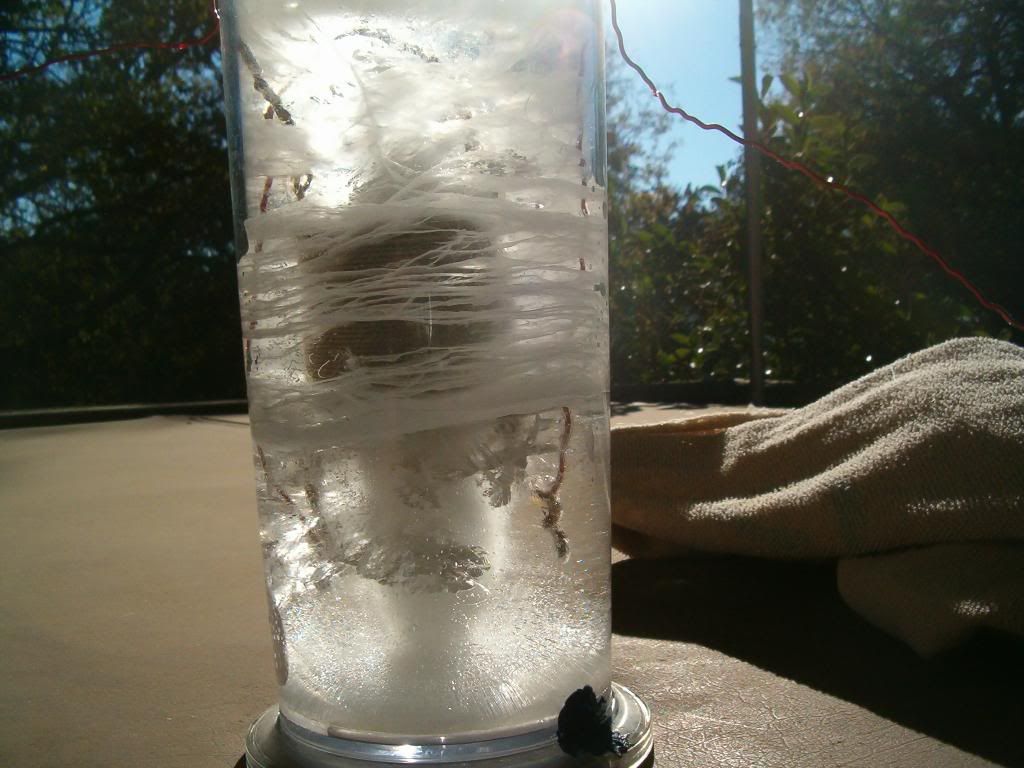
    Thought you might want to see the field of the coil that the blades are running in, this is with 12 volts, I need to freeze one with high voltage.
    Half of the Answer is knowing the right Question

    Comment


    • #17
      Originally posted by Dave45 View Post
      Thought you might want to see the field of the coil that the blades are running in, this is with 12 volts, I need to freeze one with high voltage.

      Hi Dave, Thanks for posting the link to this picture. The picture is very interesting. I think I see a wire coming from outside the frame and perhaps attached to the object in the glass container. Beyond that, I don't get it. If you would care to explain a bit further or provide a link to background information, I think it would be appropriate. Otherwise, I don't see how this relates to the testatika. By blades, you are referring to the blades of the Testatika, right? Thanks for your input.
      There is a reason why science has been successful and technology is widespread. Don't be afraid to do the math and apply the laws of physics.

      Comment


      • #18
        The theory of lightning

        I'm still chasing the idea that the energy Hermann Plauson was working with is related in some way to static electricity that occurs naturally in the atmosphere and gives rise to lightning storms by some mechanism I don't fully understand. In doing a bit of casual research, I found the following online article.

        Lightning protection theory: More fuel for the debate - Lightning Master

        According to the source posted earlier, the polarity changes when actually "in" a thunderstorm. In other words, clear sky = one polarity, cloudy sky = opposite polarity. This is easily handled by a FWBR (full wave bridge rectifier) or, if the potentials are too high, there are other techniques that any Tesla student should know. Some of these involving batteries, etc.

        Even so, as long as a low resistance path is available, the peak voltage should be controllable. So, if the reader has suggestions to make, I for one would like to hear them.
        There is a reason why science has been successful and technology is widespread. Don't be afraid to do the math and apply the laws of physics.

        Comment


        • #19
          Commercial products

          These were found on the above web site and are designed for lightning protection. Apparently they are in use at oil refinerys since there is an apparent photo of one installed in a "pipe farm"

          I have not priced them but I am sure they are grounding them and not trying to collect energy using them. In fact, the article demonstrates the controversy over pointed vs. blunt tips on lightning rods. As far as the collection of energy in concerned, there is total silence. THAT is to be expected, in my opinion. Don't expect any help from these guys!
          Attached Files
          There is a reason why science has been successful and technology is widespread. Don't be afraid to do the math and apply the laws of physics.

          Comment


          • #20
            Originally posted by wayne.ct View Post
            Hi Dave, Thanks for posting the link to this picture. The picture is very interesting. I think I see a wire coming from outside the frame and perhaps attached to the object in the glass container. Beyond that, I don't get it. If you would care to explain a bit further or provide a link to background information, I think it would be appropriate. Otherwise, I don't see how this relates to the testatika. By blades, you are referring to the blades of the Testatika, right? Thanks for your input.
            Hey Wayne
            The pic is a coil submerged in water and froze while being powered with 12 volts. Here's a pic of a coil before it was frozen its not the same setup as the pic I posted but gives you an idea as to the position of the coil. Notice the fields that surround the coil are visible in the ice.
            Yes the blades of the Testatika run in the field that surrounds the coil, these fields are called the A vector field.
            Half of the Answer is knowing the right Question

            Comment


            • #21
              Originally posted by Dave45 View Post
              Hey Wayne
              The pic is a coil submerged in water and froze while being powered with 12 volts. Here's a pic of a coil before it was frozen its not the same setup as the pic I posted but gives you an idea as to the position of the coil. Notice the fields that surround the coil are visible in the ice.
              Yes the blades of the Testatika run in the field that surrounds the coil, these fields are called the A vector field.
              Thanks. The results were quite interesting. i'm not sure what to make of it. There seems to be a "fractal" appearance in the frozen formation. Have you tried to measure the electrostatic pressure of the atmosphere?
              There is a reason why science has been successful and technology is widespread. Don't be afraid to do the math and apply the laws of physics.

              Comment


              • #22
                Im not sure how the electrostatic pressure could be measured but Im all ears.
                I havent taken this as far as I should have, I did find the ice will conduct through the core of the coil which is unusual since ice will not conduct electricity under normal conditions.

                I placed an aluminum plate in the bottom of the container about four inches under the coil froze the cell then pulsed the coil with high voltage from an ignition coil, the aluminum plate was energized with a very high voltage enough to jump a spark gap, I had no way to measure the voltage an no way to pulse the ignition coil repetitively at the time.
                I need to redo the setup and try this again, honestly I have a hunch the ice formed in the magnetic field made its own superconductor, this needs more investigation by someone who knows more about electronics than me.

                dave
                Half of the Answer is knowing the right Question

                Comment


                • #23
                  Originally posted by wayne.ct View Post
                  These were found on the above web site and are designed for lightning protection. Apparently they are in use at oil refinerys since there is an apparent photo of one installed in a "pipe farm"

                  I have not priced them but I am sure they are grounding them and not trying to collect energy using them. In fact, the article demonstrates the controversy over pointed vs. blunt tips on lightning rods. As far as the collection of energy in concerned, there is total silence. THAT is to be expected, in my opinion. Don't expect any help from these guys!
                  smaller diameter size better the results

                  try also carbon fiber broom


                  Carbon fiber
                  These SDWs are constructed with thousands of strands made from carbon fiber inside a flexible enclosure and extending about 10 to 20 cm from the trailing edges:

                  Static Discharge Wicks on Aircraft reduce Radio Interfence

                  Cold Cathode with Low Emission Threshold and High Current Density | TechLink
                  Last edited by wings; 02-26-2013, 09:31 AM.

                  Comment


                  • #24
                    Carbon fiber

                    Originally posted by wings View Post
                    carbon fiber
                    Hi @wings, thanks for the links. Good info.
                    There is a reason why science has been successful and technology is widespread. Don't be afraid to do the math and apply the laws of physics.

                    Comment


                    • #25
                      Electrostatic pressure

                      Originally posted by Dave45 View Post
                      Im not sure how the electrostatic pressure could be measured but Im all ears.
                      Hi Dave,

                      I'm sorry I was not precise. Pressure is just another word for voltage or electromotive force, a.k.a. EMF. I don't know if you have a 30 foot (10 meter) pole, but you could run a wire up to the top of the pole and measure the voltage between the ground-end of the wire and ground itself. Various shapes and sizes of "top tips" for the wire might change the voltage or current, which could be measured. The actual height, voltage, current, time of day, weather, wind, cloudiness, nearness to tall trees, etc. etc. could be recorded and reported for others to compare against. It would also help to know the details of your ground. Copper? Galvanized steel pipe? How long? Since I don't live out in the countryside, it is going to be difficult for me to do the kind of experiment that I have in mind.

                      What I will be doing is sticking my experimental "antenna" out of my second story window.

                      Warning: Don't get near this setup if the weather is bad. You might attract a lightning strike.
                      There is a reason why science has been successful and technology is widespread. Don't be afraid to do the math and apply the laws of physics.

                      Comment


                      • #26
                        Plauson energy transformer

                        Hi. I hope you can help by suggesting a source of information. According to what I read in this thread, Plauson converted about 700 volts at some current into several kW of power. Any ideas or documentation as to how he may have done this? If you had a source of power, let's say 1 kW that delivered at 500 Volts, that would be about 2 amps. P=VA; 1000=2*500. THAT sounds nearly unbelievable, to me. Now if you collect energy over time you might be able to power something reasonable for a few minutes or a few seconds, but 1-2 kW continuous with a balloon at 300 m? Am I the only one that thinks there must be a better explanation somewhere? Please share if you have any ideas on this.
                        There is a reason why science has been successful and technology is widespread. Don't be afraid to do the math and apply the laws of physics.

                        Comment


                        • #27
                          DANGER! DANGER! This unconventional energy source may be fatal

                          The risk could be easily mitigated with a lightning arrrestor or gas discharge tube that costs only a few bucks but that is still too scary for some and too conventional for others. Why doesn't anybody take this seriously?
                          There is a reason why science has been successful and technology is widespread. Don't be afraid to do the math and apply the laws of physics.

                          Comment


                          • #28
                            sauce

                            A good explanation is in Plauson's own writings, you will find a link to buy a copy of "" in PDF format with Optical Character Recognition (OCR) on the Wikipedia article about him. (I put the link there and have a copy myself ). The first pages talk about other patents and people who failed, he then proceeds with his own work. Page 61 + bits of p.60 & p.62 is about a practical experiment he did somewhere in the Finnish lowlands. I pasted that text here http://pastebin.com/JmBfeDBH. Read carefully. You have to know 1920s technical German to understand, and by the way; I would appreciate help to translate his work to English.

                            Comment


                            • #29
                              Video of similar work

                              I hope this link works. When I found it I immediately thought of this thread.

                              Also, Stator, thanks for posting on this thread. My German may be rusty but I will certainly find it interesting.

                              There is a reason why science has been successful and technology is widespread. Don't be afraid to do the math and apply the laws of physics.

                              Comment


                              • #30
                                A relevant article on an electronic design web site, electronicdesign.com

                                Note the step down transformer with the 100:1 ratio in the windings.

                                Implement A Spark-Gap-Based Design For Low-Cost Energy Harvesting | Analog content from Electronic Design

                                I have been doing some experimentation with a gas discharge tube. I have got it to discharge 15 to 200 times per second as I adjust the resistance in the RC circuit.
                                There is a reason why science has been successful and technology is widespread. Don't be afraid to do the math and apply the laws of physics.

                                Comment

                                Working...
                                X